Singing Hands Cooperative · 2014–2022 documented phases
Singing Hands: artisans, design, and livelihood.
Developed from 2014 artisan workshops and early product trials, Singing Hands launched in 2015 as a women’s cooperative paired with a student-led design agency at the University of the Pacific.
The initiative connected traditional Kam textiles and motifs with contemporary product design. The artisans supplied the craft expertise; students collaborated on products, communication, and marketing. Historical records document its development and subsequent periods of activity rather than a currently operating sales program.

PEOPLE AND PROCESS
Artisans leading the process
Wu Mengxi and the founding team
Wu Mengxi, the project’s lead artisan, worked on early prototypes with Lee and museum collaborator Joyce Huang. She also made products and brought fellow artisans into the cooperative.
The first holiday production was coordinated with the museum and supported by Pacific students and collaborators involved in marketing.


TRADITIONAL SKILLS
From fiber to finished cloth
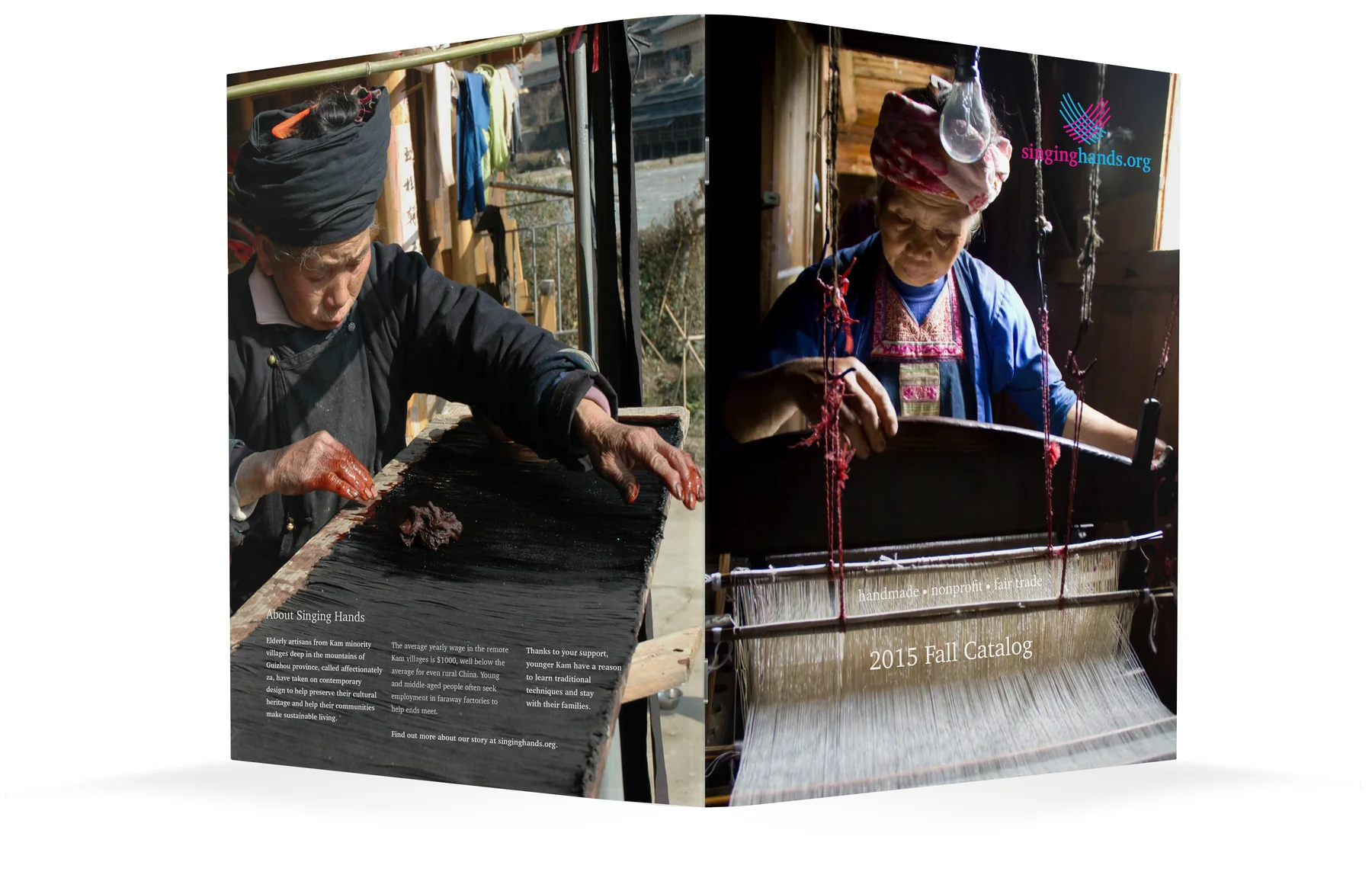
Artisans and relatives contributed weaving, hand dyeing, embroidery and assembly. Their knowledge of the materials was foundational to the objects created under the Singing Hands label.


FURTHER READING
A collaborative production model


Read original project documentation (archived)
Historical documentation of the early cooperative (2014). The activities and plans described below refer to that period; Singing Hands is currently on hold.
The Kam Heritage Project helped establish a cooperative workshop in Dimen, where local artisans developed contemporary products grounded in traditional aesthetics and local resources. During the early production period, more than ten artisans participated. The team completed a first production run and tested products at markets in the United States. Handmade and plant-dyed cloth was supplied by the artisans and their relatives, providing income from materials formerly produced primarily for family use.
The original plans anticipated refining quality, logistics, and consistent orders, with a possible approach to fair-trade wholesalers and an ambition to support steady livelihoods in the village. Those were proposals rather than evidence of certification or of subsequent expansion.
The 2014 holiday production was overseen by Joyce Huang from the Dimen Eco Museum. Wu Mengxi, who had long been an important collaborator in Dimen, served as lead artisan. She developed prototypes with Marie Lee and Huang, created products, and invited other women to join the workshop.
Marie Lee and three undergraduate students coordinated early test marketing and sales in the United States with advice from Katherine Combellick of Fordham University, associated with The Amani Project, and marketing collaborator Lowayne Shieh of Los Angeles. A University of the Pacific International Marketing class taught by Sacha Joseph-Mathews contributed to marketing planning in spring 2014.
From the early cooperative to a student agency
Singing Hands Cooperative · founded in 2015
The project’s 2014 workshops, early production, and market tests helped lay the groundwork for Singing Hands Cooperative, founded in 2015. The collaborative initiative brought together women artisans in Dimen and a student-led design agency at the University of the Pacific.
Approximately ten women spanning three generations participated, with older artisans passing skills to younger makers. Students supported prototypes, catalogs, product photography, an online presence, sales, and marketing, gaining experience in community-based and cross-cultural design.
Singing Hands was active from 2015 through 2022, including a limited attempt to relaunch the initiative in 2022. It is currently on hold.